
FeaturesInvestment engine
Investment engine
Your investment philosophy, encoded once — the same guardrails and house view for every advisor, client and agent.
Introduction & purpose
The investment engine is where your investment philosophy is encoded — the products you distribute, the risk framework you apply, and the rules for how portfolios are built. Every flow draws on the same engine, so your front office, your clients and your agents all work inside the same guardrails — and every client gets the same house view, whoever they deal with.
The engine consists of five parts:
- Portfolio collection — your product catalogue, organised.
- Datasets and calculations — the market data behind your products, and the expected return and risk the engine works with.
- Risk models — how clients are classified by risk.
- Financial situation models — how investment capacity is established.
- Portfolios and portfolio modes — how portfolios and mandates are constructed.
Together with the client components in your flows, these give every recommendation the basis a suitability assessment needs: the client's knowledge and experience, financial situation, objectives, risk profile and sustainability preferences. It is the same foundation whether you advise under MiFID II, sell insurance-based investments under IDD, or offer investment mandates.
Portfolio collection
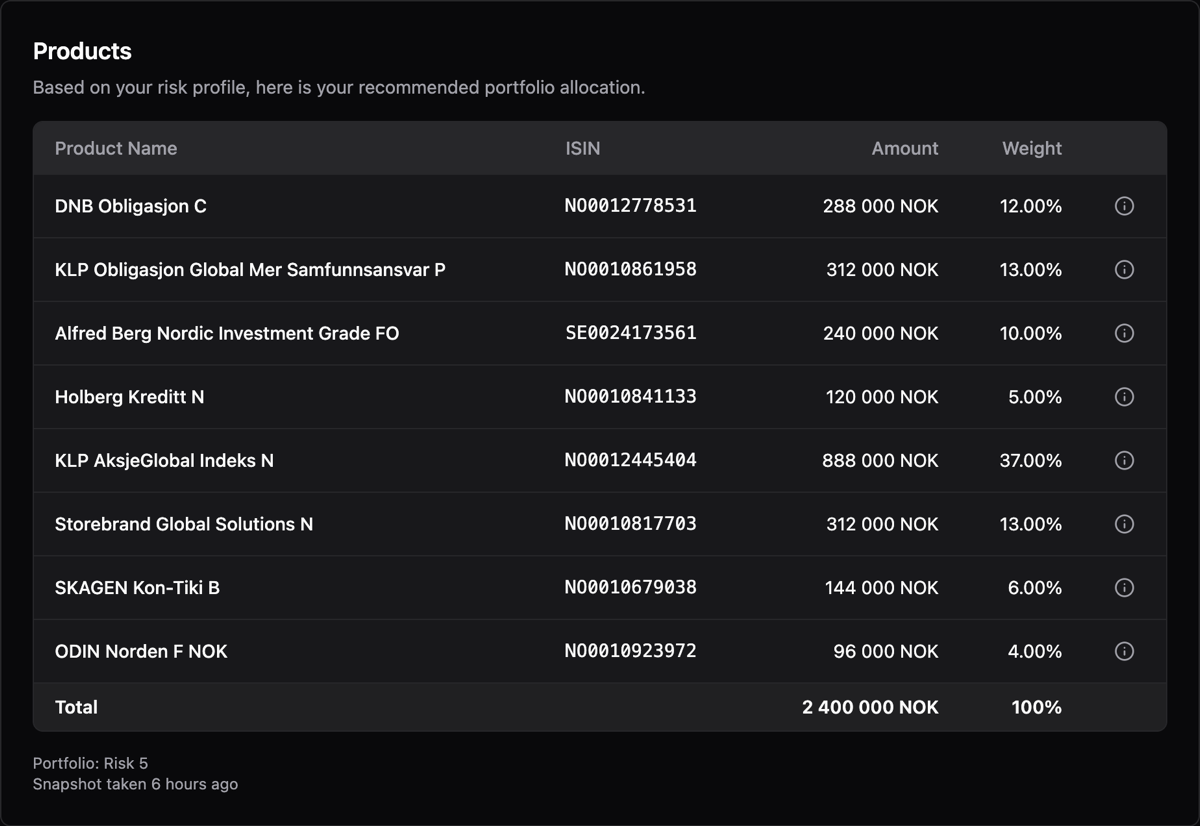
A portfolio collection is your product catalogue, organised and made available to your organisation. It holds the products your front office is allowed to distribute — your investment universe. You can have as many collections as you need; each flow runs on one collection, and the same collection can be reused across flows.
Each product in a collection carries the parameters that determine how it is presented and used:
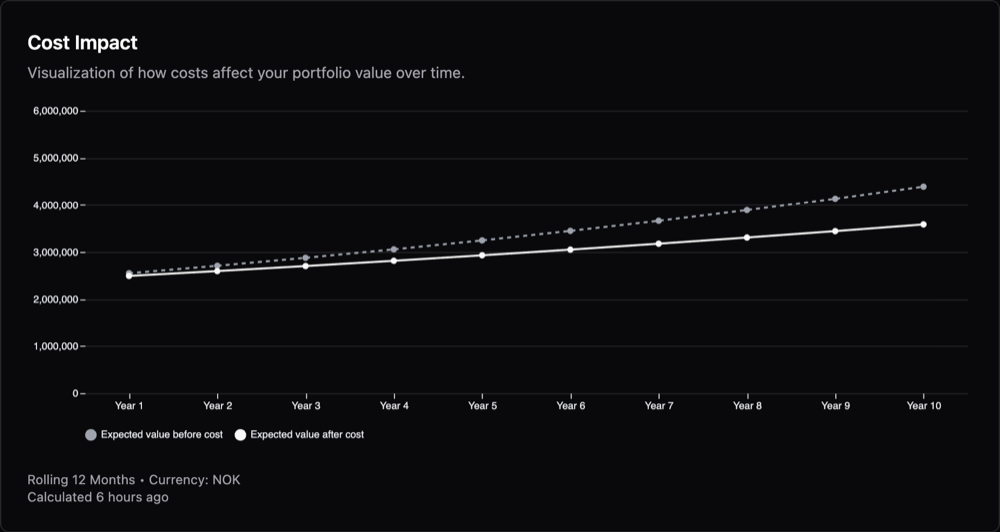
- Cost
- Documents (e.g. the PRIIPs KID)
- Suitability criteria
- Sustainability attributes
- Client preference matching
- Wrapper types for account and order management
Products can be organised into product platforms — groups such as pension products or banking products — which can be mapped to goal types and client segments, so the right products are offered for the right need.
Datasets and calculations
Every product and asset class in a portfolio collection needs a view of its risk and return. There are three ways to give it one:
- Morningstar data — map products to Morningstar Funds and Morningstar ETFs, and asset classes to Morningstar Index and Morningstar Categories. A mapped product also brings its sustainability datapoints, such as SFDR fields and EET data, and its product documents. Requires a Morningstar licence.
- Custom timeseries — upload and manage your own timeseries, for anything the Morningstar datasets do not cover.
- No timeseries — use a product without a price history and set its values manually.
You also decide what the engine calculates with. Expected return, risk and correlation can be:
- Populated from the data — calculated from the timeseries behind each product and asset class.
- Set by your house view — your own assumptions, used in full, so every portfolio the engine builds or checks reflects how your firm sees the markets.
Risk models
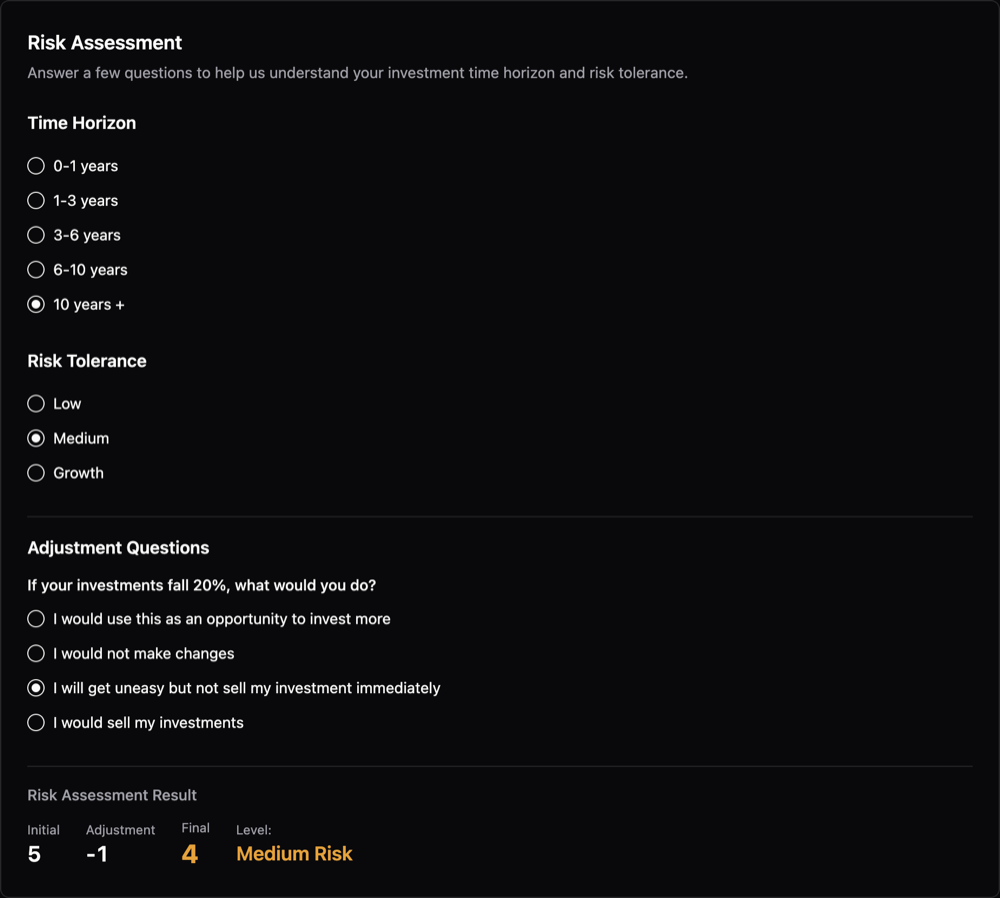
Flows that assess a client's risk use risk models. A risk model combines time horizon, risk level, and risk adjustments — answer-driven modifiers that shift the score up or down — to classify the client into a predefined risk bucket, based on their answers. Because the model is configured once and applied in every flow, equal clients are treated equally.
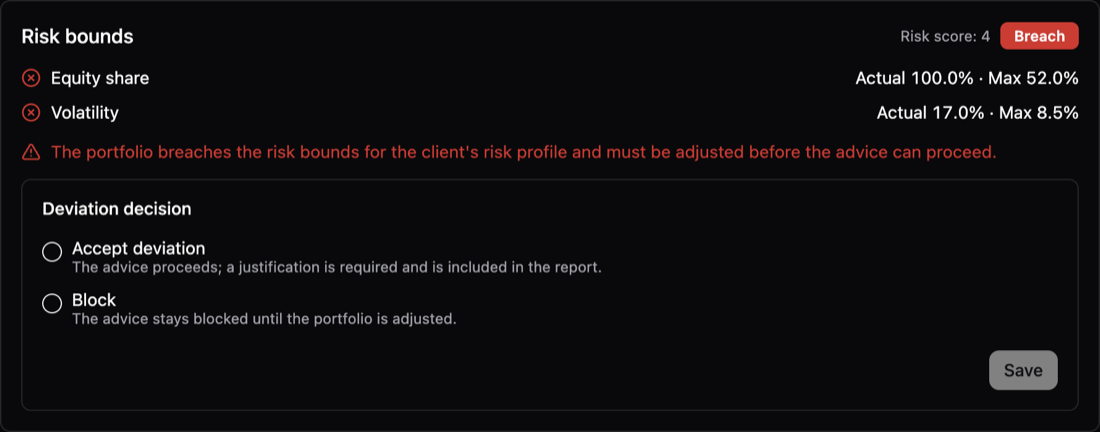
You can also configure risk bounds. As a portfolio is proposed in a flow — by an advisor, the engine, or an agent — it is validated on the fly against the client's risk score, so a proposal outside the client's bucket is caught inside the flow, not after it.
Financial situation models
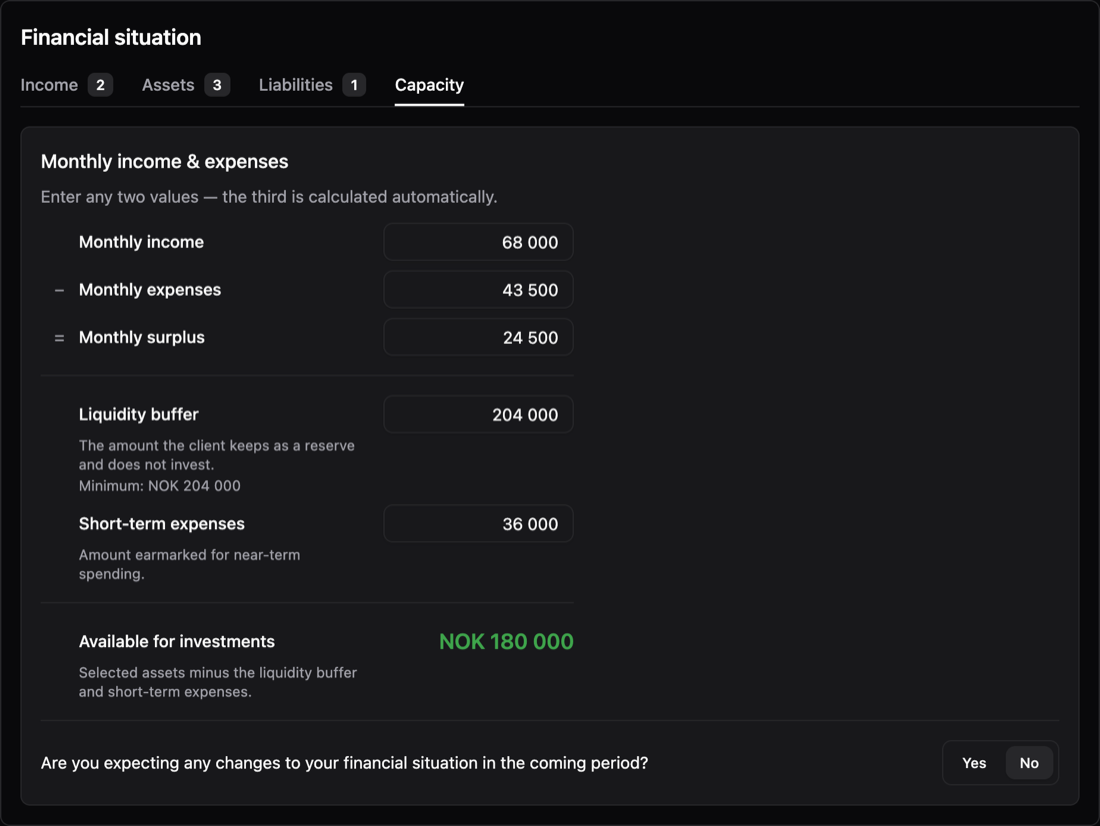
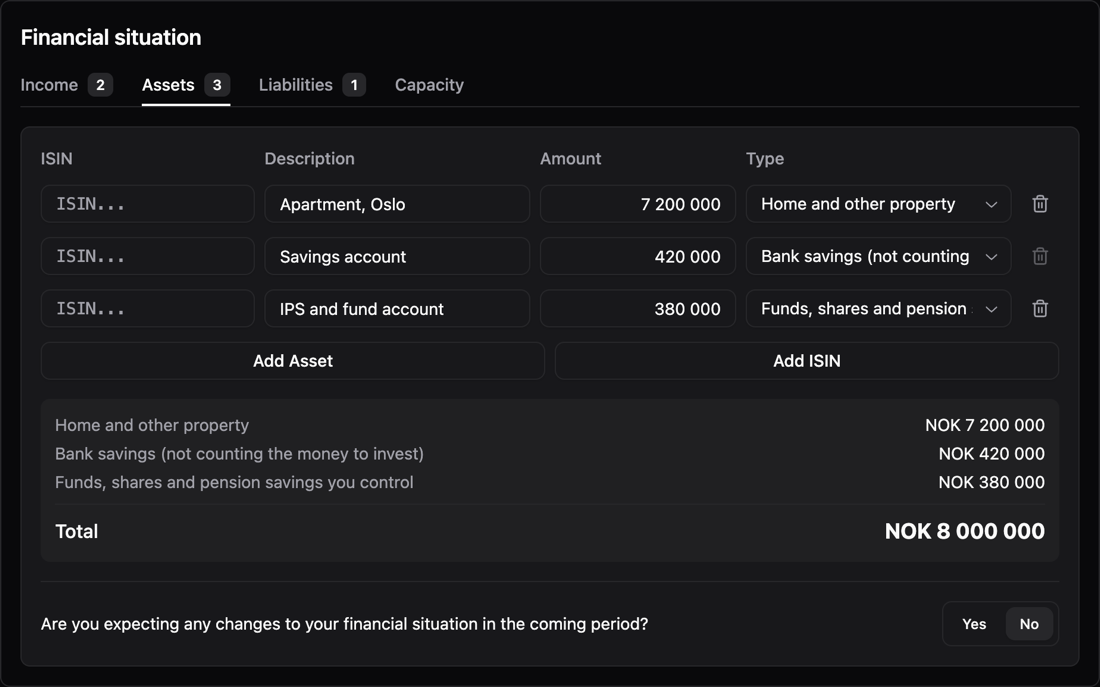
A financial situation model establishes what a client can responsibly invest. It takes their income, assets, liabilities and regular expenses, applies your rules, such as a minimum liquidity buffer and money set aside for near-term spending, and arrives at the amount available for investment. What is collected adapts to the client type: person, company or group.
The model then does two jobs as the flow runs:
- Routing — it directs the client to the product platform that fits their situation, such as pension or banking products.
- Validation — it checks every proposed investment against the client's capacity, so a lump sum above the amount available, or a monthly saving above the monthly surplus, is caught before the advice is submitted. It is the same in-flow pattern as risk bounds.
Portfolios and portfolio modes
The platform offers three modes for constructing portfolios and mandates:
- Model portfolio — the client's risk score is matched to prebuilt portfolios and mandates.
- Custom portfolio — the advisor builds freely, using any product in the collection.
- Dynamic portfolio — the engine constructs the portfolio from the client's risk bucket, their stated preferences, and the available universe — inside your rules.
Each flow can enable different modes, so you control how your front office constructs portfolios. Whichever mode is used, the result is validated against the client's risk bounds — custom portfolios included.
The engine constructs both portfolios and mandates: a portfolio is a list of products — funds, ETFs, or other instruments — and portfolios can also serve as building blocks within a mandate. This supports advisory and discretionary business alike.